
On my summer trip to run the London 10K (see separate post) , my wife and I non-revved from Seattle to London on British Airways. This was the first time I’d been on BA since the non-rev agreement between it and my wife’s airline was enhanced recently to allow us to list for Business Class when traveling on ZED fares. About six months earlier, we had gotten a courtesy upgrade by the BA cabin crew, but being able to list for the front of the plane — although requiring a modest supplemental payment — is much preferable as it provides a clear path to lie-flat provided there is space available.
British Airways non-rev notes #1: seat assignments
British Airways has become one of my favorite airlines for non-rev purposes. This is, in part, for two reasons (aside from their great route network). The first is that although the airline doesn’t allow non-revs to check in online, they do assign you a seat as soon as you check in at the airport if the loads are good enough. I’m not sure what the required number of empty seats is for this to apply, but we got confirmed Club Suites (that’s the name of their new Business Class) at check-in at SEA — and that was in the height of summer. (There was a time when summer meant more open seats in the front of the plane, because business travel traditionally slows down at that time of year, but these days “Business Class” increasingly appeals to affluent leisure travelers such that former assumptions about times of year when there would likely be open seats at the front no longer apply.)
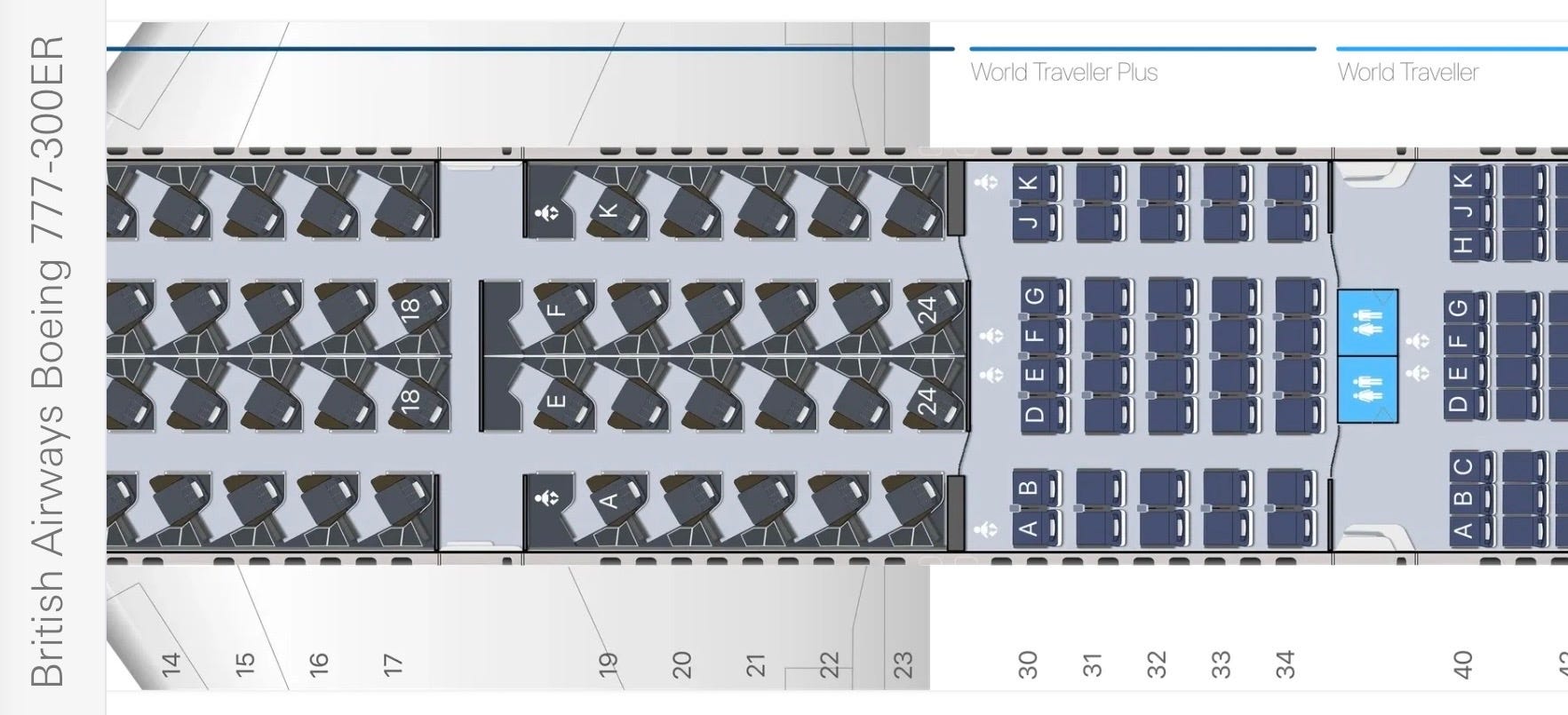
Club Suites, by the way, is in a completely different league from the old dormitory-style BA Club World Business Class seating, which, depending on aircraft type, could have you lying flat in a 2-3-2 or even 2-4-2 configuration. The old seating has not yet gone away entirely, however, so choose your flights with care. Like Lufthansa, BA was a latecomer to 1-2-1 Business Class, but its new product is highly competitive (including with sliding privacy doors). Food in BA Business Class can be a bit hit or miss, but I am happy with whatever when non-revving.
U.S. airlines, by contrast, rarely assign seats to non-revs at check-in and generally only do so about an hour or so before departure or during or at the end of the boarding process — even when there are clearly seats available. The BA approach takes some of the stress out of standby travel. Also, having a confirmed seat assigned two to three hours before departure can ease your way into those lounges — such as Amex Centurion ones — that require a confirmed seat assignment showing on your boarding pass. (Those lounges don’t bar non-revs, per se, but want to keep out people with airside access who aren’t actually traveling.)
If you are listed for Business on BA and they can’t confirm you at airport check-in, they’ll instead give you an Economy or Premium Economy seat assignment if there is one available to at least tide you over. You then stand by at the gate hoping for something better. Otherwise, if they can’t immediately assign you any seat on the flight regardless of cabin, you may — depending on the airport — either get a gate pass with no assignment or have to come back to the check-in counter at the end of revenue passenger check-in.
Returning, my wife got a Club Suites seat at check-in back to the U.S. at Heathrow, where there is a dedicated staff travel check-in desk at Terminal 5. I could have got one too, but ended up taking United (more on that shortly). The staff desk is way over to the right when you enter Terminal 5, although I can’t recall the counter number. You may come across information online suggesting that when you non-rev on BA, and out of Heathrow in particular, you should first try to check in on one of the machines, but I have never found that to work. Maybe I’m missing something or maybe it’s just an option for BA staff.
We were the only travelers at the staff travel counter when we got there, which seemed surprising given the size of BA’s operation at Heathrow. The agent at the staff check-in counter could not have been more friendly and helpful. She was more than willing to advise on loads on different flights I was thinking of taking.
British Airways has always had a positive culture when it comes to staff travel (more so than some airlines outside the U.S.). In fact, I believe the very term “staff travel” originated within BA. It’s the term that tends to be used outside the U.S. The term “non-rev” tends to be more of a North American thing.
Detour: An odd but good United non-rev experience (and the perils of standby unboarding)
I wrote just above that U.S. airlines generally assign non-rev seats no more than an hour before departure and often at the very last minute. But for every generalization about non-rev travel there is an exception. That day heading back to the U.S., I was trying to fly to San Francisco or LAX, whereas my wife was headed to Seattle. I’d listed on United to SFO, but the loads had begun to go south. There’s generally a lot of competition for United Polaris Business Class on routes like that both from United staff and from revenue passengers seeking upgrades. And the back of the plane wasn’t looking great, either. Hence I switched plans to take BA.
But then while at BA in Terminal 5, and about to commit to going on BA to Seattle (BA loads to California were also not promising), I suddenly got one of United’s “Good News” texts — those are the words they always use — about a seat assignment. Glancing down at my Apple Watch, I assumed it would tell me about something in the back, but it instead told me that I’d been assigned 16F, which is Polaris on the B787. This was with three hours to go, way earlier than usual (and I’ve non-revved on United out of Heathrow on numerous occasions — the first time, indeed, was when they’d just taken over Pan Am’s transatlantic routes after being a U.S. domestic and regional international carrier). And it was on a flight with tight loads, making last-minute assignments overwhelmingly likely. What’s more, it appeared as though I’d gotten 16F out of priority order among other checked-in non-revs.
I couldn’t quite understand it (and still can’t). But I thought I’d take it at face value and head over to Terminal 5, from which all the Star Alliance flights depart. While in the T2 United Club (which, by the way, is pretty nice), I kept refreshing the United app, half expecting to see my Polaris placement yanked. What the standby gods giveth, the standby gods can, indeed, take away. “Unboarding” — as it is called — does happen. (In fact, it happened to me on the day I finished writing this post, in Reykjavik after I was in my seat. You can read about that here.)
On this flight, however, 16F held. And I had a comfortable ride to SFO.
British Airways non-rev notes #2: premium inventory
Anyway, back to BA. I said earlier that one of the reasons it has become one of my favorite airlines for non-revving is how/when they assign seats. The other reason is the sheer size of their premium seat inventory. Put simply, they tend to have more premium seats on their wide-bodies than other airlines flying the same equipment.
Take the Boeing 777-300, for example. There, BA has 76 Business Class pods compared with American’s 70 on their newest configuration (and 52 on the older ones) and United’s 60. But the overall difference is larger. That’s because BA also offers a First Class on many of its wide-bodies, including the B777-300, which American is in the process of scrapping and United hasn’t offered in recent memory. Plus BA offers more Premium Economy seats than many other airlines.
So if you add together First Class, Business Class, and Premium Economy, you get the following total numbers of premium seats on the B777-300: British Airways: 124; American (new configuration): 114; United: 84.
What’s more, the new British Airways Airbus A380 configuration has no less than 106 Business Class pods, which take over the entire upper deck. That’s in addition to 12 First Class and 84 Premium Economy ones. So 202 premium seats of one variety or another on a single — admittedly rather large — aircraft (leaving space for 215 Economy ones).
Of course, having more premium seats does not necessarily mean that non-revs have a better chance of getting one. The higher totals could reflect BA’s ability to fill those seats with revenue passengers, including those paying for last-minute, cut-price upgrades (the bane of non-rev hopes). But, on the whole, I think higher inventory makes for better chances. ✈️ 🏃