
I’ve posted separately about the Reykjavik 10K. Here are some aviation and non-rev notes from that trip. As I noted in the other post, Iceland is a heavily traveled destination these days, and the aviation experience reflects that.
SEA-KEF on AS
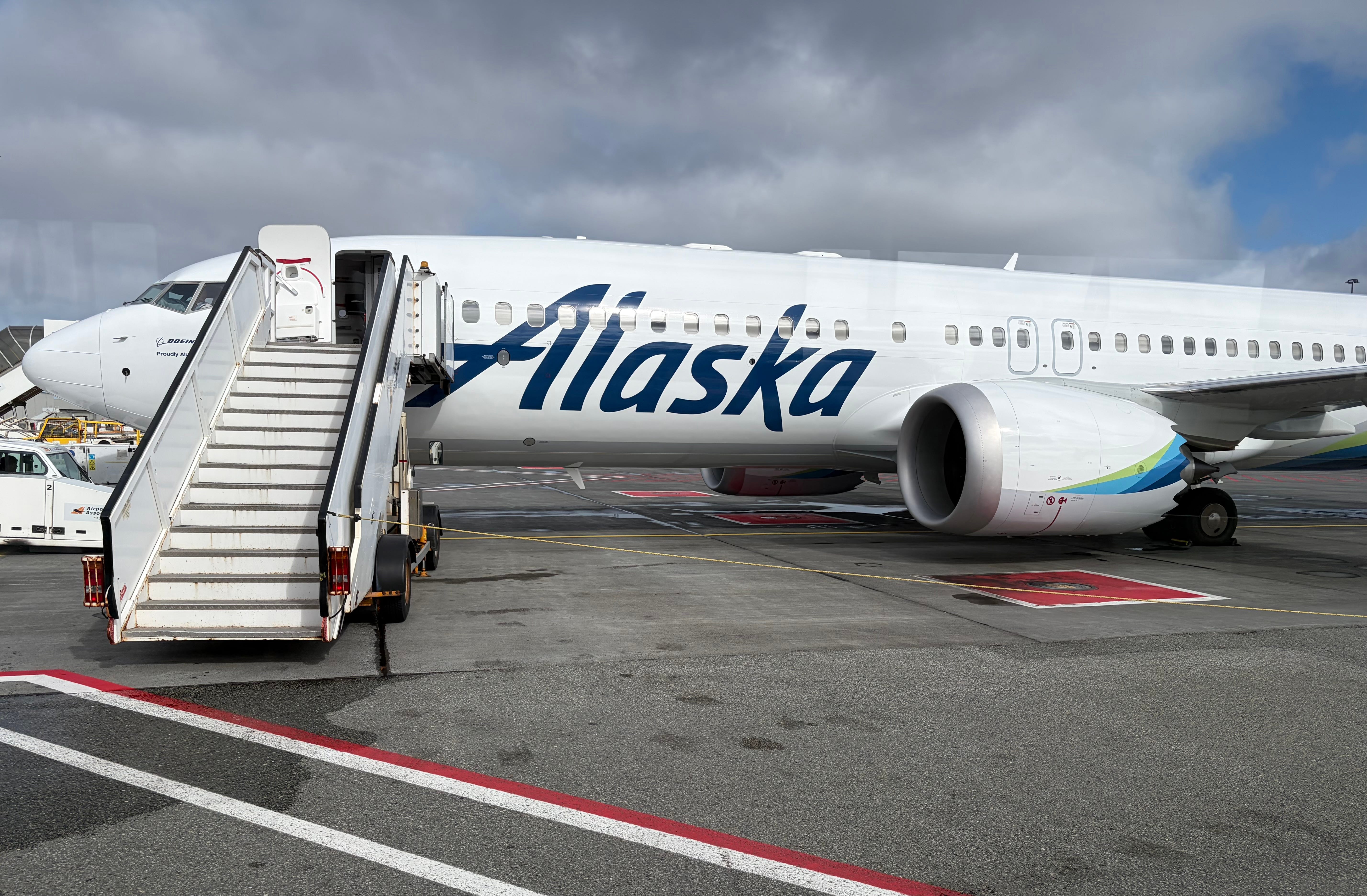
I non-revved to Reykjavik on Alaska Airlines. Alaska started flying to Reykjavik from Seattle in 2026 as part of its international expansion. Unlike its other new international destinations that use wide-body A330 and B787 equipment, the Reykjavik flights are operated on B737 narrow-bodies. But the service is a step up from the airline’s domestic flights using that aircraft. They serve a warm wrap in economy as well as wine and beer for free. It was a nice flight — about seven and a half hours — albeit a pretty full one. Alaska is well on its way to putting in free Starlink WiFi across its entire fleet, and this flight came so equipped.
Weight restrictions
Standby travelers are warned that because of the long distance, flights between Seattle and Reykjavik might sometimes go out with seats kept empty for weight-and-balance reasons. The airline generally books them for about nine seats shy of the number on the plane. Those seats might be released to standbys at the last minute based on fuel and expected flight time, but don’t count on it. On the outbound, they did eat a little into them to accommodate standbys.
Returning, the loads were tight, and it was a nail-biter as to whether I’d get a seat assignment. At the very last moment, I was called to the desk and given a boarding pass. It was a middle seat, but I was happy to be on. Things got better once on board, as the guys on the aisle and window were traveling together and offered me the aisle so that they could stay next to each other.
But then…
When you see ground staff wearing high-visibility yellow jackets boarding a flight shortly before departure, it can mean various things. Sometimes, it can be good news for non-revs. I’ve had the ground staff hand me a last-minute boarding pass for first or business class. But knowing what I knew about potential weight restrictions, and that my chances of being seated in First on this flight were as sub-zero as the coldest Icelandic winter temperatures, my heart sank when I saw an agent start to walk down the aisle.
I prayed she would go past me to attend to something or someone else. But, no, her destination was, indeed, my row and, in particular, the middle seat to which I had been assigned. I volunteered to her that she was probably looking for me, now seated on the aisle. And she, deeply apologetic, broke the news that the captain had decided to put on more fuel such that they needed me off the plane. Yes, all it took to make the aircraft good to go was to remove one passenger.
Non-rev protocol is clear in such moments. Comply instantly. Do not complain. Grab your bags. And start the Walk of Shame.
Fortunately, I was seated fairly close to the front, so that it wasn’t a walk through the entire cabin. But no doubt passengers who observed were wondering what “wrongdoing” must have led to my removal.
The flight attendants standing at the aircraft door commiserated. But the Walk of Shame continued beyond the door. The plane was on a remote stand. So I walked down the stairs in full view of those looking out of windows on the left-hand side — alone, like a President descending the steps of Air Force One, except carrying my own bags — and then over to a waiting bus, which was laid on just for me for the lonely drive back to the terminal.
A ride on Icelandair
Non-revving home after that debacle proved challenging. I won’t regale you with the full tale, except to say that none of the flights back to the U.S. were looking promising, and I even considered flying to mainland Europe and returning from there. In the end, though, I took my chances on an Icelandair flight to Denver and snagged a middle seat in the last row.
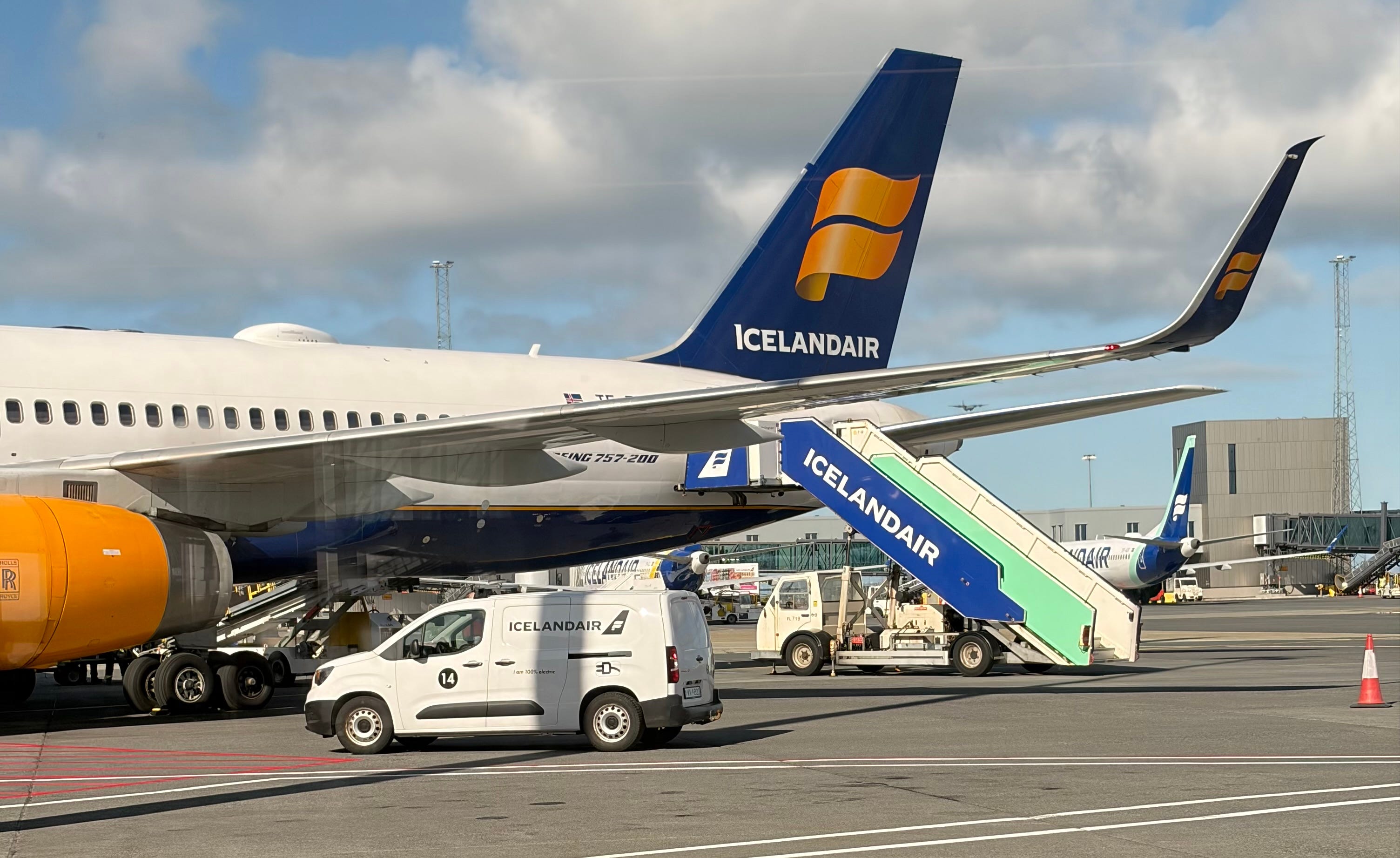
I was grateful to get on that flight. But Alaska has the edge when it comes to the overall experience on flights between the U.S. and Iceland (albeit with only one route to offer). Icelandair is not an ultra-low-cost carrier. However, its back-of-the-plane product feels a bit like one. Nothing is on the house other than water, not even soft drinks, let alone any food. And certainly not WiFi. That said, if all you want is transport, no airline flies to Iceland from more cities in the U.S. and Europe than it. So it is a convenient if unexciting option.
I never did make it home to Southern California that day, but that was no fault of Icelandair. Major thunderstorms were causing havoc with air travel in the western United States and the Southwest flight I was planning on taking from Denver canceled. I ended up getting as far as Phoenix, where I overnighted in the terminal, relieved that there is an Admirals Club there that opens at 4 A.M.
The B757 and wake turbulence
The Reykjavik to Denver flight will probably prove to be my last ever on a B757. Icelandair will be retiring its elderly 757 fleet quite soon, and most major airlines have already done so.
The B757 was a solid workhorse. It is also the only narrow-body that air traffic controllers handle much like a “heavy.” The “heavy” moniker applies to aircraft capable of takeoff weights above 300,000 pounds, since those produce a stronger wake. On radio frequencies, “heavy” is added to the callsigns of those aircraft. The suffix warns other traffic (and perhaps reminds the controllers themselves) of the heightened risk of dangerous “wake turbulence.” That term refers to the disturbance of air trailing behind an aircraft, mainly a pair of rotating vortices shed from the wingtips as the wings generate lift, which can affect a following aircraft — potentially with serious consequences.
The 757 is below the “heavy” takeoff weight threshold (which, as a practical matter, is reached by only wide-bodies). However, the FAA established heightened separation rules for the aircraft, treating it like a heavy. This followed, in particular, a fatal accident in 1993 in which a private jet carrying executives from the famed In-N-Out Burger chain lost control when encountering a United 757’s wake on approach to Southern California’s John Wayne Airport.
If you fly small airplanes, as I used to back in the day, you need to be careful about wake turbulence from any jet, regardless of whether it is classified or treated as “heavy.” I got spooked by a controller’s advisement — “caution wake turbulence” — even flying behind something like a Citation.
The trick on approaches when following a jet, as I recall, is that in addition to maintaining adequate longitudinal separation, it is prudent to fly a little above the normal glide slope, since that should put you above the sinking wake. But staying above the wake is not a viable option when departing, as jets climb faster than small piston planes. There, it is prudent to wait for the wake to dissipate before taking off and then, when possible, to turn to a heading that will further help avoid it. I used to angst a lot about wake turbulence, maybe more than necessary — but at least I never encountered any.
Last solo
My last ever solo flight was out of the aforementioned John Wayne Airport, incidentally, flying to Santa Barbara, where I had to make an unforeseen instrument approach down to near minimums as fog unexpectedly moved in. It was the first time I had done that in “actual” (as opposed to simulated) IFR — “instrument flight rules” — conditions, and it actually went remarkably well. ✈️ 🏃
If you enjoyed this post, subscribe for free. And share it with someone else.