
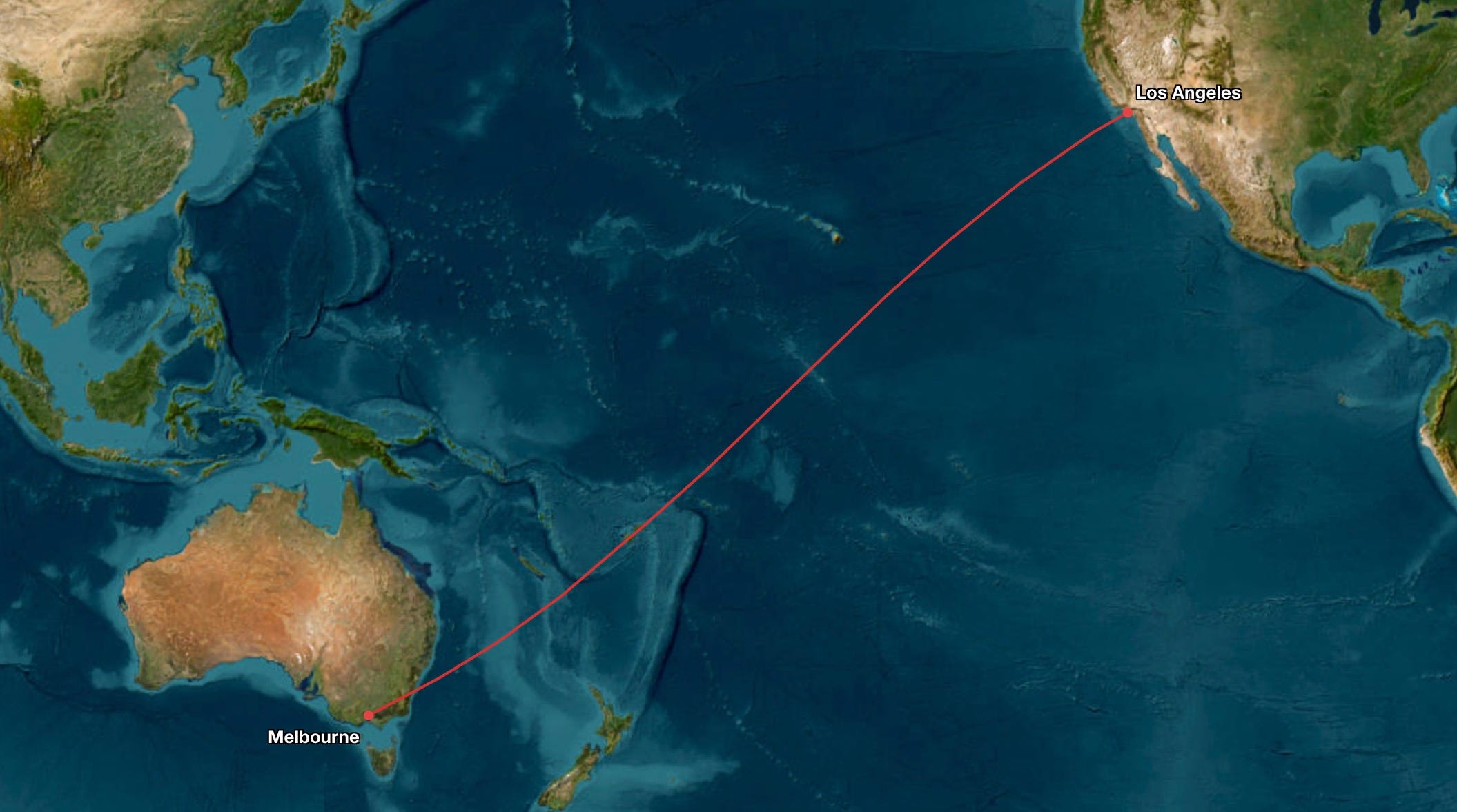
I recently non-revved to Melbourne, Australia, for the half marathon there. You can read about the race and my time on the ground here. This short post is about the aviation side of the trip.
Getting there
United and Qantas both fly nonstop to Melbourne from Los Angeles and San Francisco. Qantas also flies there from Dallas and Honolulu. I believe American has flown to Melbourne in the past. There are no nonstop flights from Europe.
Traveling standby, I was able to snag United Polaris Business Class from Los Angeles to Melbourne and had a great flight. But the arrival experience at Melbourne was less satisfactory (no fault of United).
Less than stellar immigration
I’m not sure whether it is often like that, but the immigration process when I landed in Melbourne was a mess with vast crowds of people coming off different international flights trying to funnel into an overcrowded arrival system — bodies pressed against each other like on a crowded subway — and people seeming not to have much of a clue as to whether they were waiting in the right place. I figured a way through the system, but suspect that most took much longer than me. (Hint: Go/do where/what most other people aren’t going/doing. That goes for a number of things in life.)
Before you even fly to Australia, you need to get one of those electronic travel authorizations that, while technically not a visa, amounts to the same thing. You do this on an app on your phone and, in theory, it should only take a couple of minutes. The problem is that you may encounter a problem with the app taking the required photo. It must have taken me about 100 attempts spanning over two days before it finally took mine. At times, I began to think I just wouldn’t be able to go to Melbourne. Sometimes you think it is working, but you then get a message rejecting the photo. But my problem wasn’t over when I finally got it to work. When I then answered a question stating I was a dual national, it wanted to take the photo again for some reason. Eventually I obtained my clearance, but my advice is not to leave this to the last minute.
Others have reported similar experiences in forums like Reddit. The problem seems to exist only on iPhones, not Android devices. But there is no clear pattern as to why some people encounter it and others don’t. I tried all manner of settings, lighting conditions, and backgrounds. When it finally worked, I wasn’t doing anything different from what I had tried numerous times before. Hopefully the app will improve (and, to be fair, I had no problems with my 2023 trip to Sydney).
Surprisingly, after all of this, United didn’t even want to check to see if I had obtained the authorization when I departed the USA. But maybe their system connected with the Australian immigration one to match the clearance to my passport number.
Non-revving on Qantas
Non-revving is a bit like my day job (law and alternative dispute resolution), as you always learn new things. I didn’t fly in either direction on Qantas, but learned a few things about non-revving on them as I positioned myself to do so. The first is that when you list for a flight determines your place on the standby list within your priority level, not when you check in. I’d never previously known of an airline that does this.
The second is that Qantas premium loads change a lot in the last 24 hours. I believe that’s because they run an auction system trying to encourage revenue passengers to pay for last-minute upgrades. So what might seem like a very promising Business Class non-rev scenario can change quickly and fundamentally. Nonetheless, I did get offered Premium Economy for the outbound. But it was a middle seat — and I rolled the dice hoping for Business on United and won.
I was very impressed with the Qantas app, incidentally. It gives staff travelers a lot of information on which to make informed decisions. It is not quite in the same league as the United app — the best in class worldwide — but it is significantly better than most.
On the way back from Melbourne, it was a bit different. The United and Qantas flights to California were scheduled to go out within an hour or so of each other. I’d planned on taking Qantas in this direction with the hope of getting Business on the A380 but prepared to be happy with whatever I got. However, Qantas was facing a long delay — six hours plus. I was afraid it would cancel. An A380 from Sydney had cancelled the day before. So I took United and ended up in the back of the plane — still a decent flight, with an empty seat next to me. I’d already checked in for Qantas and tried to cancel once I knew I’d be taking United, but the system wouldn’t let me — I think because it was too close to the original scheduled departure time even though it was hours from the actual one.
In the end, the Qantas flight didn’t cancel. So when I was airborne over the Pacific in United Economy and connected to WiFi, I started getting tantalizing seat assignments from Qantas once its flight was closer to its heavily delayed boarding. First, it was an aisle in Premium Economy. But then an hour or so later, I had been moved to Business — and, what’s more, to the holy grail for solo non-rev travelers, an upper-deck window in the 1-2-1 layout. So in that case, the Qantas trend was the opposite of on my outbound — the loads got better. That may have been a function of some revenue passengers finding other flights because of the delay.
My Qantas ZED fare was, like all non-rev tickets, refundable. But I nonetheless don’t like being a no-show on a non-rev ticket, even though I couldn’t avoid it on this occasion. Still, this vignette evidences the truth of the non-rev wisdom that you don’t know what the final outcome is until the plane pushes back. Which, in this case, was after I was in the friendly skies.
United non-rev Business Class refunds
The other thing I learned on this trip is that United will refund me the difference if I list for Business standby but end up being seated in Economy. Not all airlines do that. The United policy was always a bit unclear to me, and it may differ depending on which airline you or your loved one works for. Also, the refund process is different from that for unused — as opposed to downgraded — listings. But it does remove part of the stress of standing by for a premium seat.
You don’t get a refund if you list for Business and get seated in Premium Economy, however. So if you prefer an aisle or window in the back to a middle in Premium (as do I), you need to get officially downgraded after being “upgraded,” rather than just switch seats once on board — or the system won’t record where you ended up sitting. Maybe they won’t refund, however, if it was a voluntary downgrade. I haven’t tried that out.
No gate passes in Australia
No matter which airline you non-rev on out of Australia, don’t expect to be given a pass to standby at the gate itself. You need to be confirmed before you go through security — regardless of what the airline’s normal policies are. If your flight is pretty open, you may — depending on the airline — get a confirmed seat assignment when you present yourself at the check-in desk a couple of hours or more ahead of departure. But don’t count on it. So be prepared for the dash to the gate after revenue check-in closes and no or minimal lounge time. ✈️ 🏃
If you’ve stumbled across this post, please consider subscribing to the Flyrun blog using the button below. It covers the intersection of running, travel, and aviation. Subscribing costs nothing (and never will). You’ll get an email every month or so with a new post. Please also share this post with anyone you think might be interested. You can see an archive of previous posts here.